
School parents demand answers on fire ant plan
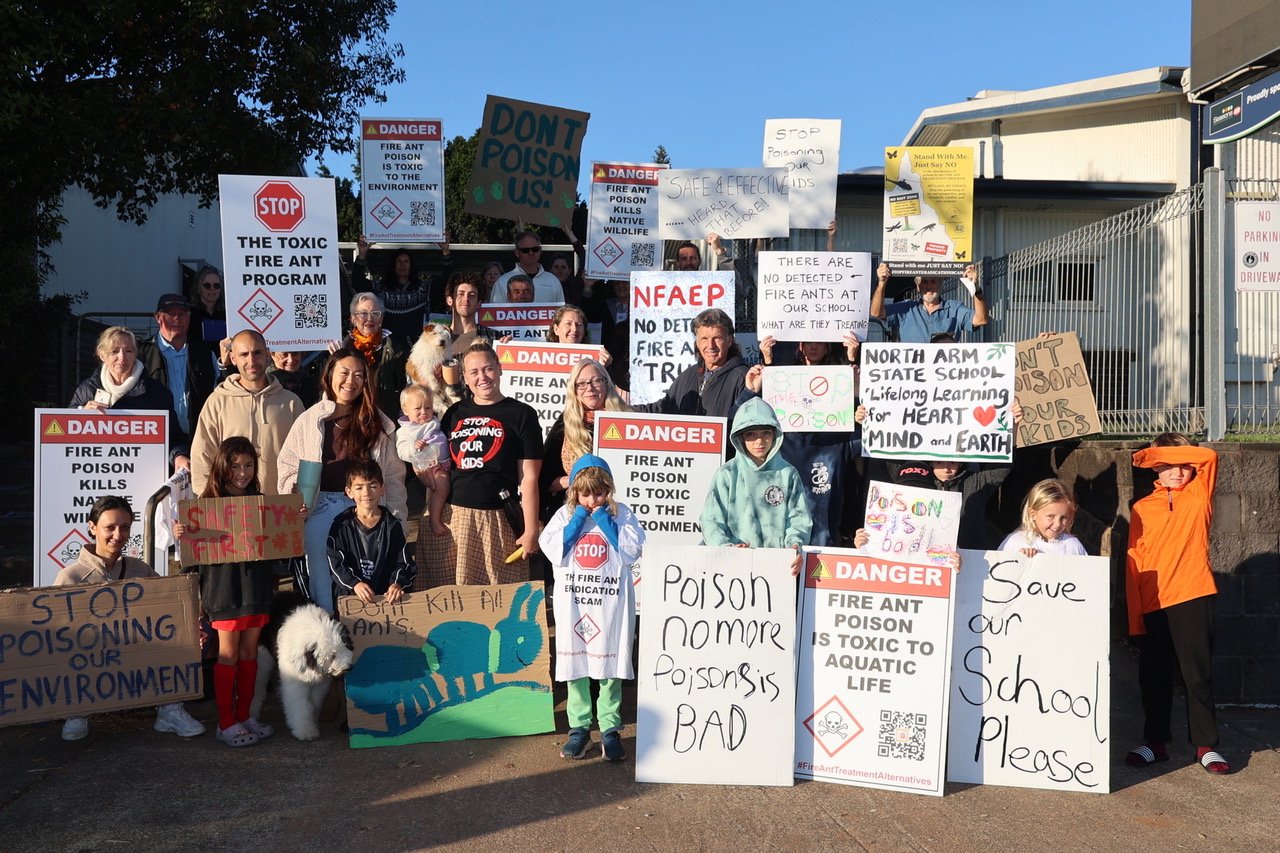
Signs of protest: parents and students rally outside North Arm State School on Saturday against the fire ant treatment.
by Cameron Outridge
About 40 parents and students gathered at North Arm State School on Saturday morning for a peaceful demonstration against the methods proposed for a planned fire ant treatment on school grounds.
Armed with posters, families called for greater scrutiny of the National Fire Ant Eradication Program’s use of insect growth regulators, particularly at schools and other places frequented by children.
The demonstration followed a community information meeting and a petition which attracted 185 signatures within 24 hours before being presented to the school.
Parent Jess Daniels said families were not satisfied that questions about exposure, exclusion periods and possible long-term effects had been adequately answered.
She said parents had been told there were no known fire ant nests within the school grounds and wanted to know why preventative treatment was necessary.
“What are the long-term health impacts on our children?” she asked.
Parents have sought further details about the product’s ingredients, application rate and environmental persistence, as well as safeguards for children and pregnant women.
They have also questioned whether monitoring or targeted treatment of detected nests could be used instead of preventative treatment across the school grounds.
Sarah McGuire, a chartered accountant from Samford who has spent more than two years researching and challenging the eradication program, joined the demonstration.
Ms McGuire stressed she was not opposed to controlling fire ants, but objected to broadscale pesticide use, compulsory property access and what she considered fear-based messaging.
“Fire ants shouldn’t be here, and it would be better if they weren’t here,” she said. “But if you want to manage them, do it in a safe way that’s not damaging our environment.”
Ms McGuire began examining the program after receiving notice in March 2024 that her property would be treated despite no fire ants having been found there.
“They said they can come on my property without my consent. They don’t need my consent,” she said. “I was like, ‘I don’t even have fire ants on my property, and yet you’re now saying I have no choice.’”
Ms McGuire said her concerns grew after she began researching the chemicals being used.
“They were insect growth regulators, which aren’t a toxic poison straight away,” she said. “It doesn’t kill immediately, but it makes the ants infertile.”
She said her principal concern was what she regarded as the absence of a comprehensive environmental risk assessment covering treatment on such a large scale.
Ms McGuire also questioned whether eradication remained practically achievable and urged greater consideration of alternatives, including using pressurised hot water to treat identified nests. “Is the risk worth the benefits?” she asked.
Treatment officers had not arrived when the initial demonstration concluded, but some parents remained nearby and others returned after being advised the team was on its way.
Ms Daniels said three program vehicles entered the school shortly after midday and officers completed the treatment by about 12.40pm. Police attended and an additional padlock placed on the school gate was cut with bolt cutters.
Parents were not permitted to enter the grounds during the application.
Ms Daniels alleged granules were spread on sand and artificial turf in the prep playground, despite parents understanding those areas would not be treated. She said parents recorded parts of the application and later saw birds eating some of the granules.
She also questioned what happened to the treatment following dew and rain after granules were no longer visible.
National Fire Ant Eradication Program response
The National Fire Ant Eradication Program said fire ants had been detected in North Arm and surrounding areas.
Under the Fire ant response plan 2023-27, all properties, including schools, within 5km of known detections are treated to eliminate colonies which may be present but not yet detectable.
The program confirmed there were no known fire ants at North Arm State School but said nests could remain undetected for several months after an infestation occurred.
“By the time a nest becomes visible, it may already have produced new colonies,” a spokesperson said.
The program said multiple treatment rounds were required because surveillance alone could not detect every fire ant colony.
It said fire ants posed a serious threat to people, the environment, the economy and Australia’s way of life. Children were considered particularly vulnerable because fire ant stings could cause painful injuries and, in some cases, serious allergic reactions.
The program said the granular treatment contained corn grit, soybean oil and a small concentration of either pyriproxyfen or S-methoprene.
The active ingredient comprised 0.5 per cent of the product, with 100g applied to a 500sqm block containing 0.5g of active ingredient.
The program said the treatments had been assessed, registered and approved by the Australian Pesticides and Veterinary Medicines Authority and were safe for people, animals and the environment when used as directed, including around children and pregnant women.
It said insect growth regulators broke down quickly, did not persist in the environment long-term when used as directed and became undetectable within days.
No exclusion period was required following treatment.
The program said its officers applied the product in accordance with strict safety and operational requirements and wore personal protective equipment as a standard workplace requirement when handling approved treatments.
• Ms McGuire’s website is www.treatfireants.org. More information about the eradication program is available at fireants.org.au or by phoning 132 ANT (13 22 68).
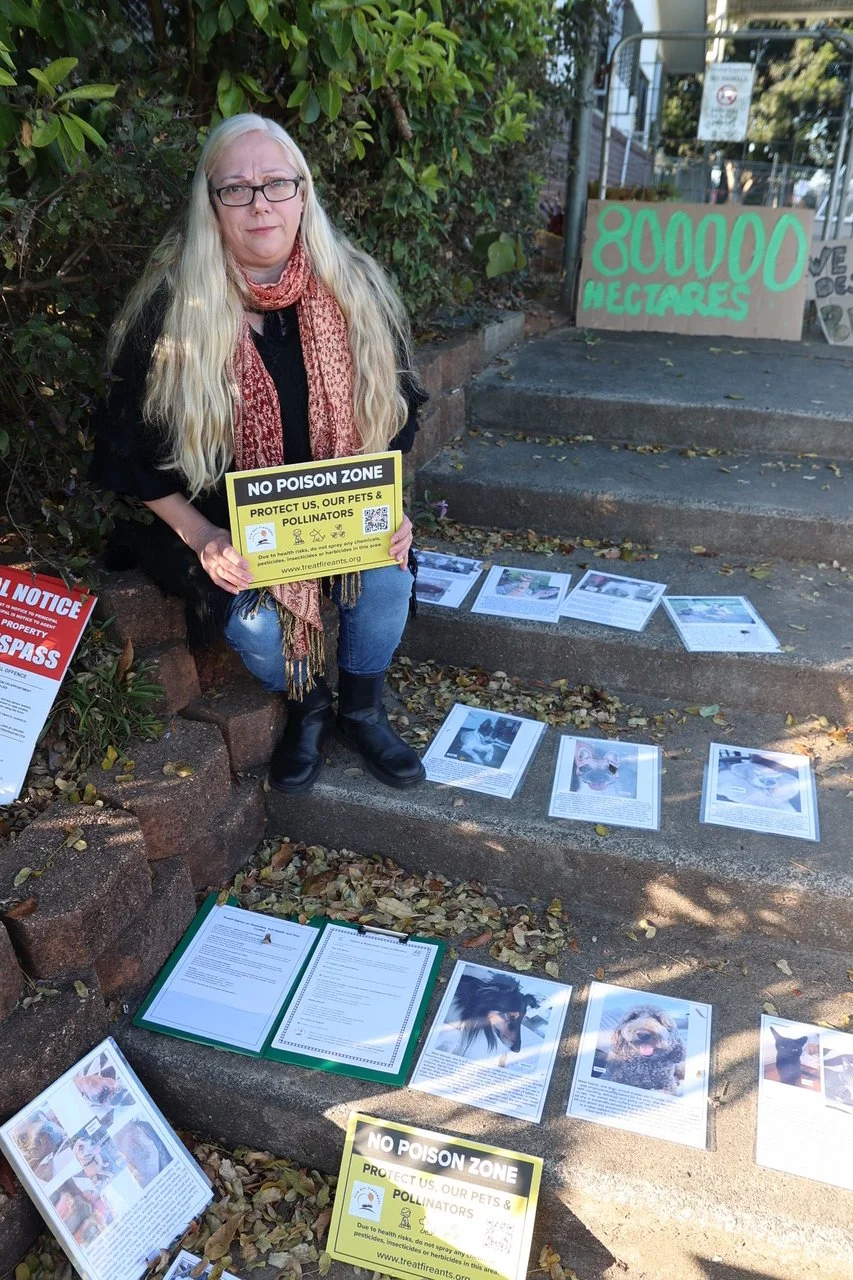
Sarah McGuire says she supports controlling fire ants but opposes the eradication program’s methods & messaging.