
Letters: Morning glory, Montville pub, homelessness & local newspapers
Save Witta’s rainforest before it’s too late
Thank you to all who contacted me. I was reminded of a lesson I used to share in my workshops — just how little rainforest we have left. There is not an endless abundance.
We are a very special rainforest region. It is our natural heritage. Yet we now have only around 40 per cent of the original species, and we have an obligation to restore the balance, as so many residents are trying to do. We cannot afford to lose another tree, let alone a whole forest complex. This area has never even been fully surveyed, and Koala's can't survive in morning glory.
Much of the southern end of the Blackall Range does not have enough intact forest to survive into the distant future without rehabilitation. Now we face the imminent loss of one of the largest areas at Witta on Kenilworth Road. To understand what’s at stake, drive through the Conondales or visit Lamington National Park, which covers 20,000 hectares with 200km of walking tracks. By contrast, the only significant walking area in our region is Mary Cairncross at just 65 hectares, with a 2.5km track, used by half a million visitors a year.
Council, together with TMR, has planted 500,000 trees around the Curramore soil dump — but into morning glory, against my expert advice two years ago. As I warned, the trees are now smothered by morning glory. Meanwhile, on Kenilworth Road, above the waterfall, I have held back morning glory for eight years waiting for the containment lines Council promised. I even secured $20,000 for that work, but it has never been done. Yet Council has spent $250,000 of the Environment Fund on the trees that are now choked by weeds.
It is a travesty if this destruction is allowed to continue. We must restore the balance, not destroy it. I am calling on residents to urge Council to act responsibly. We only have a few weeks, but the forest can still be saved.
Would it not be wonderful for visitors to drive along our roads through rainforest instead of weeds? That would truly be something special to share.
Fall in love with a local rainforest tree — we have around 350 species to choose from.
– Jeanette Nobes, Dip. Conservation and Land Management
On the importance of letters to the editor
As an avid reader of local newspapers, I was very pleased to see the Sunshine Valley Gazette is once again publishing Letters to the Editor.
Recently the new President of Country Press Australia, Damian Morgan said “…My top priority as President of CPA is to fight for the publishers who, in turn, are fighting for their communities. We’ll be wearing out the boot leather lobbying governments to protect our people from exploitation by tech platforms that profit from harmful content and put our children and democracy at risk…”
Local newspapers serve as platforms for regional views and offer alternatives to mainstream media which is largely controlled by one corporation. Corporate and city interests dominate, while global tech companies are reducing local newspapers’ revenues and jeopardising their existence.
By supporting local businesses who advertise in local papers we will help their survival in these challenging times.
When reliable sources provide Australians wherever they live with information, they can assess policies, identify misinformation, and engage effectively in democratic activities.
Right now, some democracies are facing challenges. Maintaining our democracy requires ongoing attention, and being informed, and that starts at the local level.
– Robyn Deane, Nambour
Ed’s note:
Hear, hear! And thanks Robyn. Rest assured I print as many letters as I can. But space is tight and they sometimes have to give way for community news and other items. Meanwhile, Facebook is a great place to have an immediate say on the stories we post there. In some ways, for the Gazette at least, Facebook comments have become a popular real-time alternative to letters to the editor.
– editor Cameron Outridge
Social housing needed for the homeless
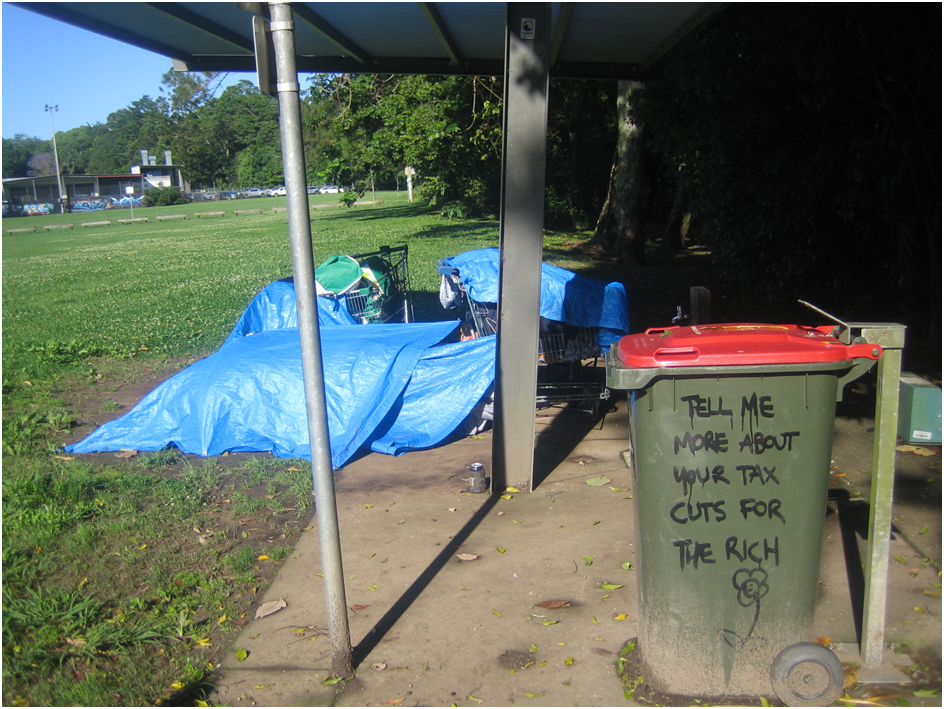
Pic: Christine Bennett
Government policies are directly responsible for the current crisis of homelessness, here in Nambour. For decades, all levels of government sidelined this preventable issue, failing to provide sufficient levels of social housing. Then, Moreton Council declared that homelessness is illegal. (Where else can homeless persons camp, other than public land?). And Brisbane Council enforced the removal of tents. Evidence of a chronic social housing emergency is highly visible: the end result is ongoing harm to the homeless and repercussions for the community.
To criminalise homelessness is to criminalise survival. Here is how this situation has become a lethal cycle: Once on the street, most applicably with long-term homelessness, drug addiction is virtually inevitable. Life is impossibly hard for homeless campers, especially when the weather is beyond endurance.
When people can’t cope with the harsh reality of their lives, substance abuse becomes their only refuge. Once addicted, the cost of renting social housing becomes a lost hope, since the need for drugs takes precedence and the cost of addiction precludes it. At this point, those trapped by dependency are caught in this lethal cycle, as the addiction takes over.
So, the ‘choice’ to remain homeless is a callous Catch 22 that many will not survive. For some, it is already too late. Drug addiction is a life-threatening disease that, without treatment, claims lives.
– Christine Bennett, Nambour
Homelessness a symptom of larger problem
When will we stop looking at homelessness as a problem and start looking at it as a tragic symptom of a larger, more ingrained problem?
When will we stop criminalising homeless people and treating them as lesser by dehumanising and demonising them and start acknowledging that they haven’t chosen to be homeless as a preference, but by circumstance?
Moving homeless people on doesn’t fix the problem. It masks the symptom. Yes. Our parks will be prettier. We will feel less confronted by despair, squalor and poverty but, the homeless people will still be homeless, just homeless somewhere else, further away from all the services we all enjoy and homeless people desperately need.
The most vulnerable of the vulnerable will be even more vulnerable but, at least we can go home to our comfortable beds behind our locked doors and don’t have to see or think about homelessness. Out of sight, out of mind isn’t a fix.
It allows homelessness as a societal symptom, stemming from the neglect and mismanagement by decades of governments across all three levels and all political persuasions to fester and worsen.
We concentrate on the importance of constructing infrastructure to meet the deadline of the 2032 Olympic Games from a huge shortage of construction industry workers. We do our utmost to attract maximum interstate and international migration in front of the 2032 Olympic Games. Who is building the houses to accommodate these people who are relocating to an area of maximum demand and minimum supply? This equation is one of increasing inequality which will continue for at least the next decade.
It will further drive up rents as supply continues to weaken and demand increases.
Currently, there is no ceiling on how much a landlord can increase rents. With approximately a third of the population being renters, there is no shortage of people to replace those forced out of the rental properties that they have transformed into a home and who have lost everything including their dignity.
– Anthony Sullivan, Nambour
Montville doesn’t necessarily ‘want a pub’
As a participant in Montville’s June Futures Forum and a member of the Montville Village Association (MVA) working to enact some of the recommendations of that forum, I believe that I must challenge the claim that Montville wants a pub.
What came out of the forum was that a significant proportion of the Montville community represented at the forum believe that Montville wants a more convenient opportunity to purchasing alcohol for home consumption (a local bottle shop) and a local venue more conducive relaxed community discussion over a drink (a bar).
Mention of a pub did happen in these discussions but my understanding is that it was largely dismissed.
Not only is the ‘Montville Wants a Pub’ claim inaccurate, it could re-ignite a debate that has divided the community since 1908 and we have far more important community issues to address.
– Doug Patterson, Montville