
Complex build, tight budget, safety first: Why Nambour’s tram is taking so long
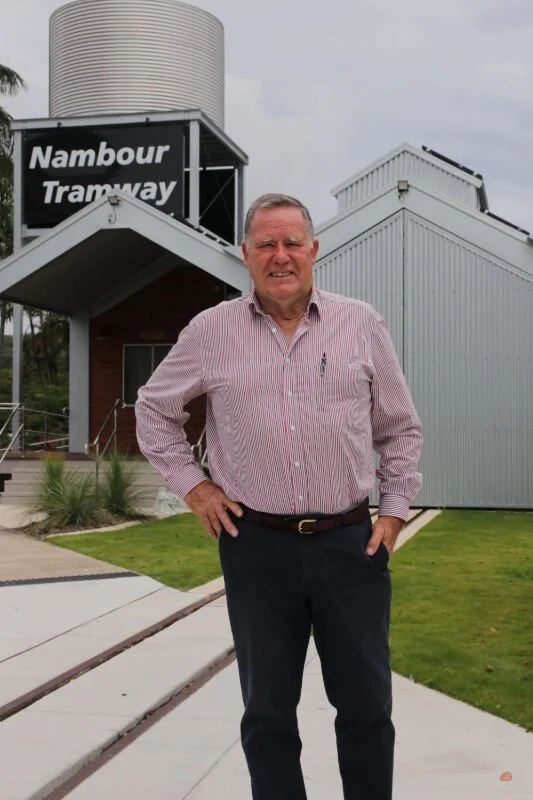
Chairman Greg Rogerson at the Tramco terminus in the CBD.
Nambour’s much-anticipated Tram has become one of the town’s most discussed projects. It’s been praised, questioned, criticised and passionately defended in equal measure. With the project stretching over many years, the volunteer-led Nambour Tramway Company (TNTCo) has faced growing scrutiny from residents who simply want to see the tram running.
This week, chairman Greg Rogerson agreed to answer a series of questions put to him by the Sunshine Valley Gazette, hoping to explain what has caused the holdups, where the money has gone, and why the TNTCo Board remains committed.
Mr Rogerson said he spoke not as a sole decision-maker, but currently as one of seven Board Directors each with equal voting rights. All are unpaid volunteers carrying responsibility for every engineering and operational decision.
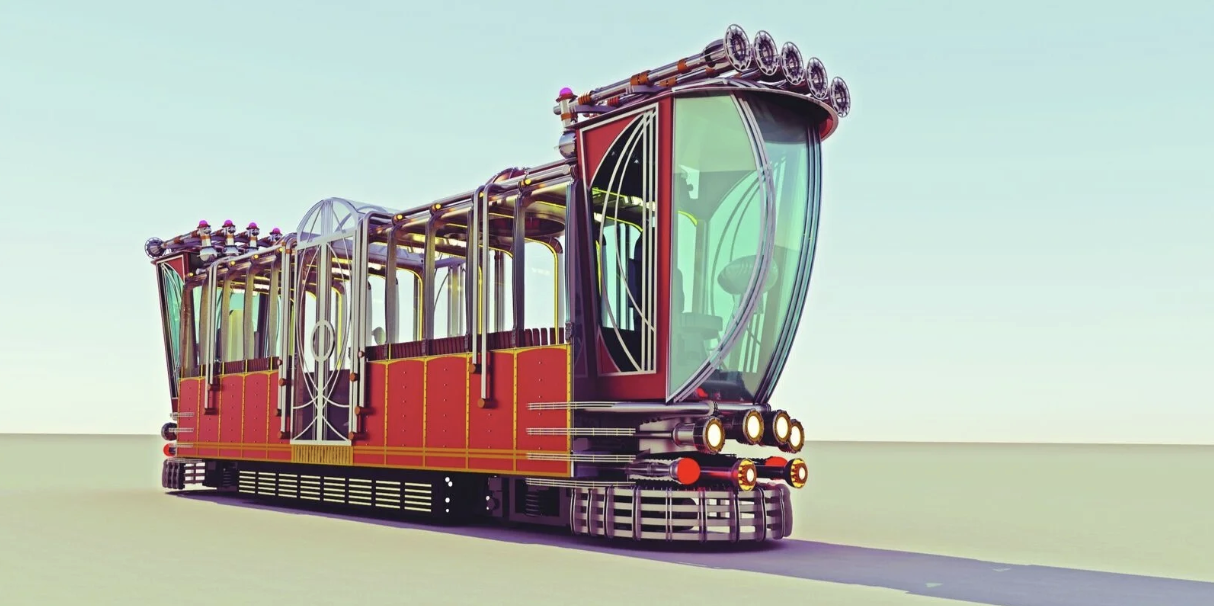
An artist’s impression of Russell Anderson’s steampunk design tram.
Following is a Q&A that aims to give readers an understanding of the project’s challenges and progress, and the human effort behind it.
Q: Can you understand why locals are frustrated by the delays?
“I certainly can appreciate some people’s frustration,” Mr Rogerson said. “But in recognising this frustration I also want to make it abundantly clear that the entire TNTCo Board, who are all ‘non-paid volunteers’, are endeavouring to steer this project as best they possibly can and that means being meticulous in every aspect of the project build.”
He said every Director is committed to delivering the safest and highest-quality tram possible, even if the process has taken longer than expected.
Q: What are the main reasons behind the delays?
Mr Rogerson said the Board had grossly underestimated the complexity of engineering required for a bespoke tram that operates legally within a public road corridor.
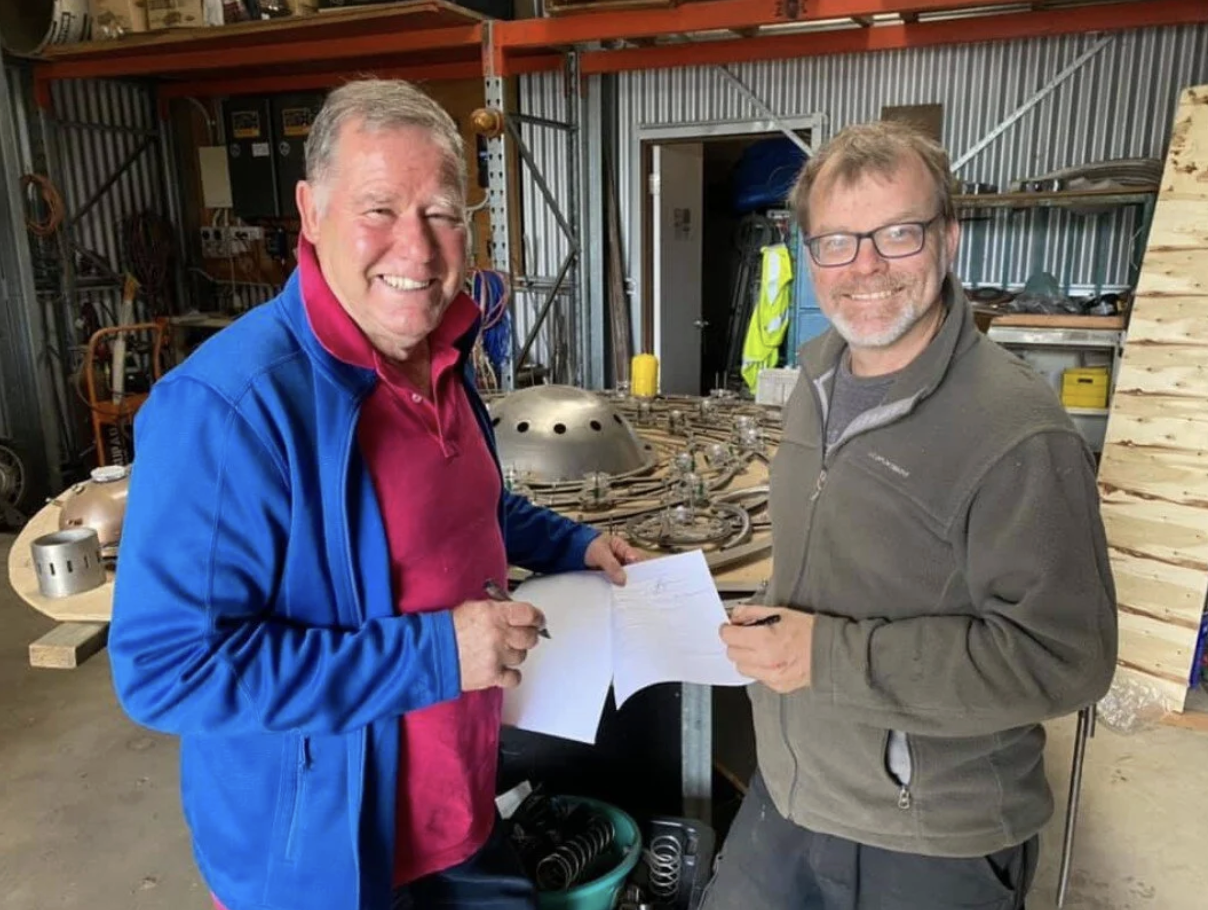
Greg Rogerson and artist Russell Anderson sign the agreement to build the battery powered, solar regenerative tram that will feature interactive technology, also pictured.
The compliance process has been complex, rigorous and at times daunting and cited the below professional input:
• in-house mechanical engineers
• Registered Practising Engineers of Queensland (RPEQs)
• an Independent Competent Person (ICP)
• the Department of Transport and Main Roads (TMR)
• the Office of the National Rail Safety Regulator (ONRSR)
He said “TMR was involved initially, but ONRSR have been continuously involved right throughout the entire Tram Project.”
“There is an age-old adage that says, ‘In engineering, money dictates the level of engineering achieved and most importantly, the speed that it is achieved!’”
For years, engineering work was provided pro bono by Covey Associates. When this arrangement ended in mid-2024, TNTCo kept with the firm under a reduced commercial rate and also contracted Leap Australia to undertake additional Finite Element Analysis. The additional costs stretched the budget – but, he said, “strengthened the build.”
“For those who are negatively judgemental on the time the project has taken thus far, please consider the disproportional, low level of finances that TNTCo is working with in bringing this bespoke Tram to fruition and the fact that the Nambour Tram will be operational within a public road transport corridor, hence TNTCo’s prime concern is safety.”
He emphasised that Board members would not take shortcuts and would not stray from sound engineering design, protocol and subsequent advice.
Q: Where is the project up to?
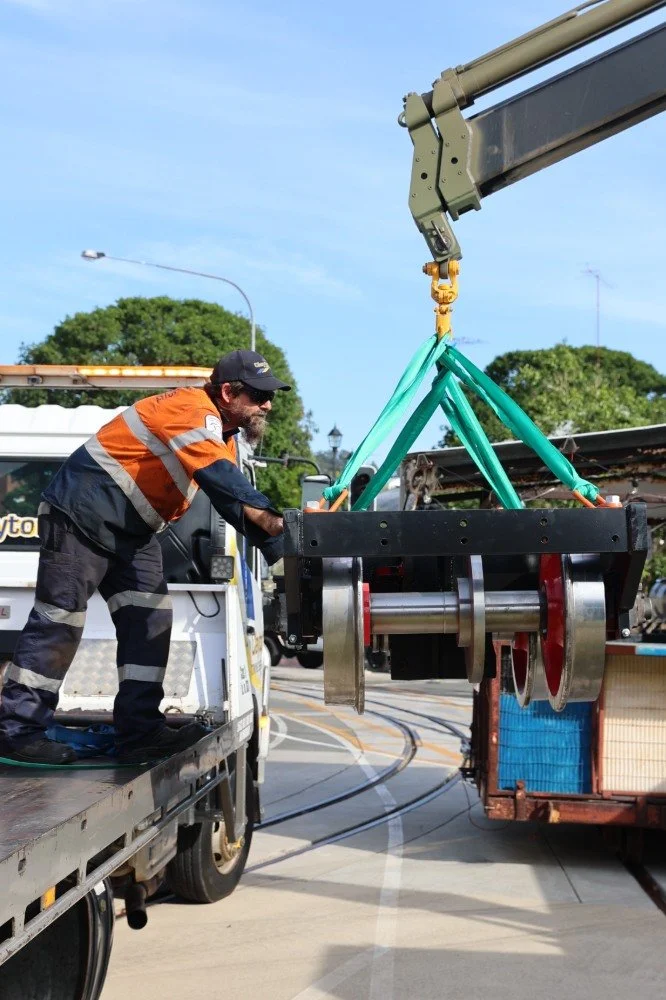
Mr Rogerson said the two bogeys – the motorised running carriages – are “built and ‘somewhat’ operational”. Testing is well underway.
“When I say operational, I mean we could run them up and down the internal tracks within the Tram Terminus… however, for safety reasons we currently have each drive wheel axle assembly raised from the track and placed on jack stands.”
The testing has confirmed electrical design, motor synchronisation and regenerative braking.
Meanwhile, Leap Australia is finalising engineering for the chassis and superstructure. TNTCo hopes to have these designs approved by Covey Associates mechanical engineer and the RPEQ within the next few months. All documentation and drawings will then be sent to TNTCo’s ICP, in Melbourne, for their professional rail specific scrutiny.
Components already purchased include swivel, motorised driver’s seats, internal seating, glazing, exit/entry doors, copper cladding, lighting and the list goes on and on.
Mr Rogerson said the Tram will be built inside the Western Tram Terminus:
“This should give the community and visitors to our region, an excuse to pop their heads in, and see firsthand where the construction is at.”

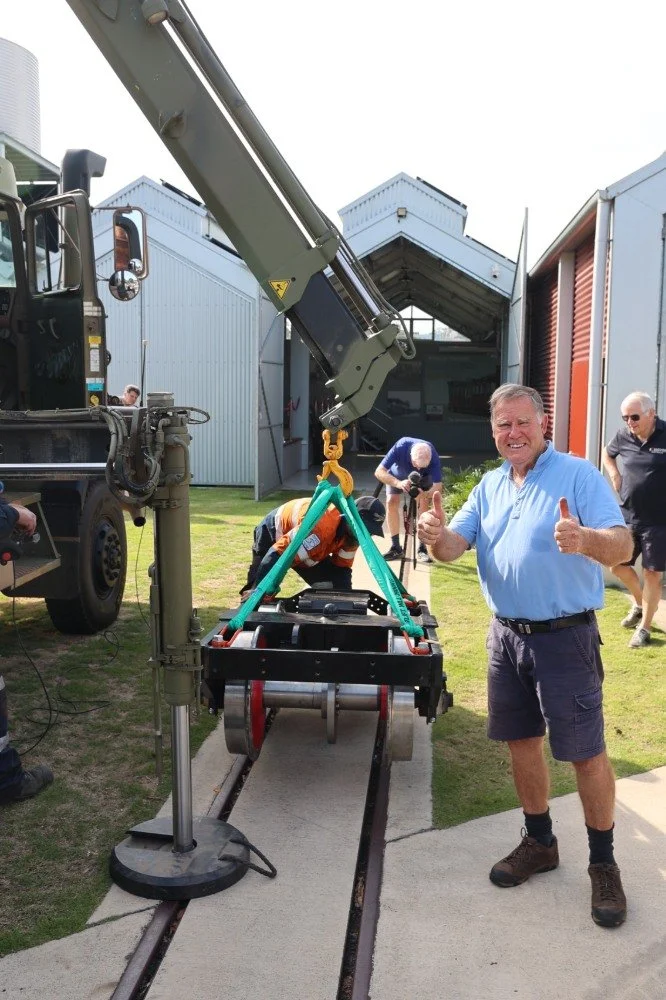
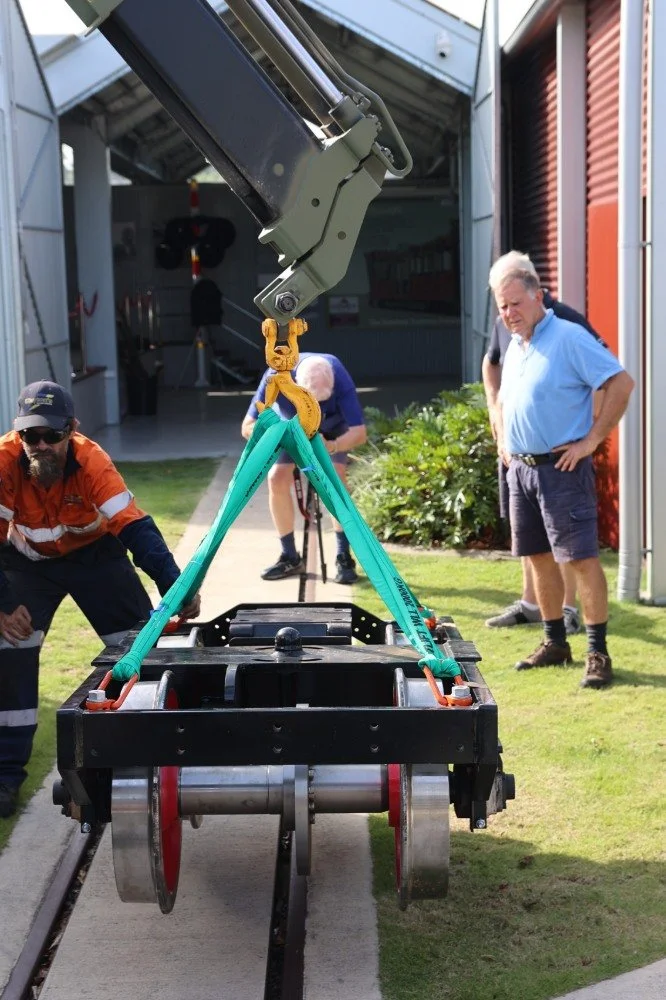
Q: Can you see the light at the end of the tunnel? When might it be finished?
“It’s a very well used pun, but I can actually see the light at the end of the tunnel burning brighter, little bit by little bit,” he said.
TNTCo’s current forecast:
• Tram completed by the end of 2027
• Commissioning in the first half of 2028
He acknowledged earlier projections were too optimistic. “We were naïve regarding the complexity and rigor required to take on such an enormous project. At no time did I or the Board, deliberately give false or misleading information to our valued community.”
Q: What visible progress should the community expect next?
Within the first three to four months of 2026, TNTCo hopes to have:
• sign-offs from engineers and regulators
• a contract awarded for chassis construction
• a second contract in place for the stainless-steel superstructure
“Whilst there won’t be much, if any visible progress in the first six months of next year,” he said, “by Christmas of 2026, I would hope that the community would see at least the chassis mounted on the bogeys and a significant work in progress on the superstructure.”
Q: There have been accusations about funding transparency. What do you say to that?
“TNTCo has always been open and honest in each and every aspect regarding the Tram project,” Mr Rogerson said.
He provided detailed expenditure figures up to 3 December 2025:
• $61,356 on plant and equipment
• $1,220,111 on the Western Terminus
• $1,723,654 on track and signalling
• $731,953 on the tram
Total spent: $3,737,074
All figures have been audited up to 30th June 2024. Subsequent figures will be audited in the near future.
He also addressed online commentary directly:
“In the past and at present, there has been a lot of financial conjecture and defamatory accusations levelled toward me and the entire TNTCo Board on social media.”
“To those misguided folk, I pledge that every TNTCo Director does their share of the workload for the Nambour Tram Project as completely unpaid, volunteers.”
Q: If you’d known how hard this would be, would you have begun?
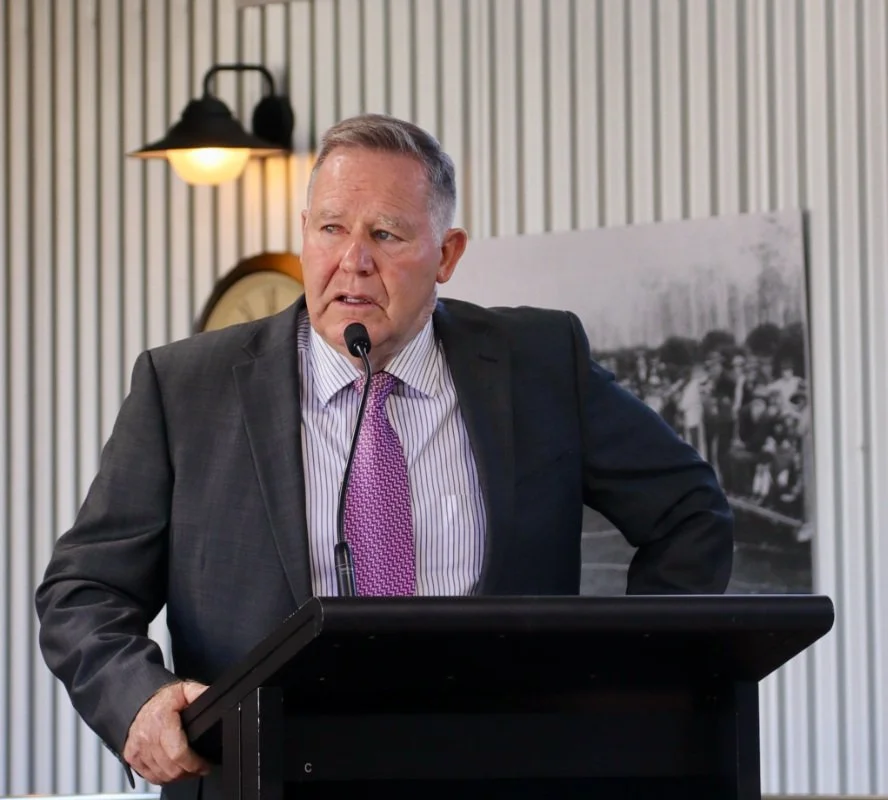
Mr Rogerson at the project launch.
“Initially, I said that if I’d known what was in store for us at the beginning, I probably would have backtracked at a great rate of knots and run as fast and as far away from the project as I could… But now I can honestly say that I thoroughly enjoy being a part of what I believe will be, a genuine, real tourist attraction and game changer for Nambour.”
He said if the Board hadn’t stepped up, “it seems that no one else would have done anything for the great town of Nambour,” and he is now “exceedingly proud” of the project.
“I would have certainly done all the work over a dozen times more, to reap the expected returns for Nambour.”
Q: What else would you like to say?
Mr Rogerson offered heartfelt thanks to his fellow directors:
“Thankyou for your friendship, our shared vision, your enduring hard work and most of all, thanks for staying the distance.”
He also paid tribute to philanthropists Roy and Nola Thompson, Rod and Jan Forrester, Mal and Judy Pratt and Kevin and Anne-Maree Covey. “Your financial contributions toward the Nambour Tram Project will never be forgotten and always appreciated, no end.”
He also thanked the more-than 50 volunteers who had donated skills, labour and goodwill in the Tram Terminus build and Tram Project in general.