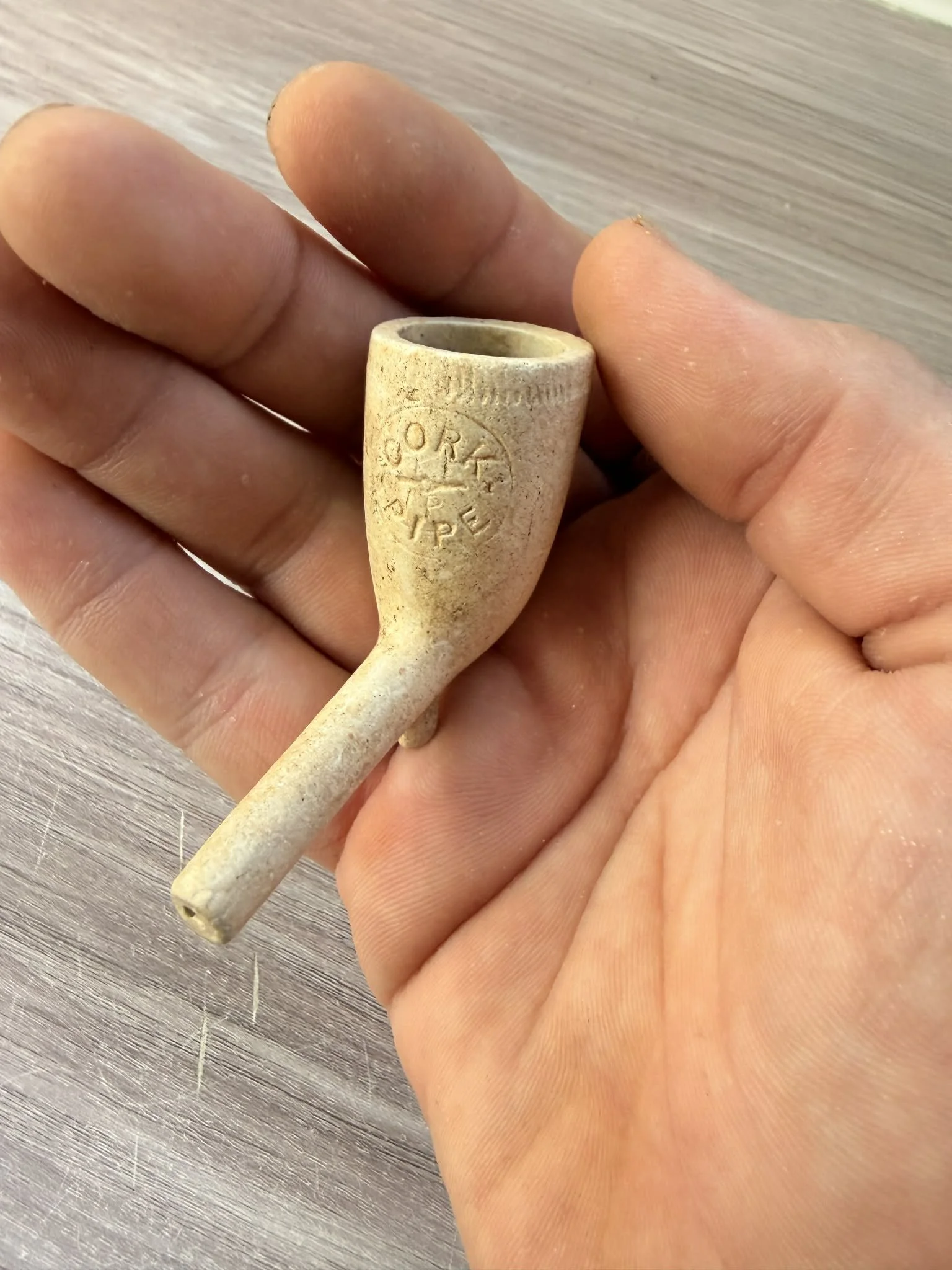
Rare Irish ‘cork pipe’ unearthed in Nambour creek
A quiet morning fossick along Petrie Creek has led to a significant local discovery and rare glimpse into Nambour’s early European history.
A local resident, who has asked to remain anonymous, says he recently uncovered what he believes to be a 19th-century Irish clay “cork pipe” while exploring creek banks in the Nambour area.
After researching the find and comparing it with other documented discoveries, he believes it may be one of the first examples of its kind recorded in the immediate area.
He has photographs and video footage of the pipe, along with research pointing to similar finds elsewhere in Queensland. The most recent comparable example he could locate was recorded in Mackay in 2018. He believes the Nambour piece appears to be in notably better condition than those previously reported.
The pipe has since been examined at the Nambour Museum, where staff confirmed it was a 19th-century Irish clay “cork pipe”. “They were initially surprised by the condition and provenance,” he said. “After I showed them video footage of the discovery, they were satisfied it was a genuine local find. They said it would fit perfectly in their men’s section.”
Despite the name, so-called “cork pipes” are made of clay, not cork. The term refers to Cork in Ireland, where many were produced.
“The material is quite distinctive and, when damp, has a slightly adhesive feel,” he said. “That’s characteristic of clay pipes from that era.”
Irish clay tobacco pipes were widely used throughout the 18th and 19th centuries and are often associated with early European settlement. In Queensland, most examples were imported from Scotland and Ireland in the mid-to-late 19th century.
They have been recorded at sites including Brisbane’s Frog’s Hollow and Albert Street excavations, Fraser Island middens, and Mackay beach, and are frequently discovered by bottle collectors or during construction work at historic coastal and mining locations.
Often found broken, they typically feature larger bowls and, if lacking a base spur, are indicative of or post-date the 1850s.
From his research, the Petrie Creek example appears to be in unusually good condition. “Many comparable pieces show significant weathering and wear,” he said. “This one remains largely intact except for the snapped mouthpiece, which would have been roughly twice as long. I have not cleaned or altered it in any way since its discovery.”
The resident describes himself as a fossicker and local history enthusiast. “I fossick regularly when time permits and have done so throughout various parts of Queensland,” he said. “I have a strong interest in uncovering and preserving small pieces of the past.”
He has been exploring local creek areas for several years, often collecting rubbish along the way. “I’ve never found anything like this before,” he said. “I do find a lot of weird and random things now that have obviously been discarded into the creek instead of the bin.”
He said conditions along some sections of the creek had changed noticeably in the past 12 to 18 months. “Increased rubbish, including hazardous waste such as uncapped needles, has become more common,” he said. “I have also experienced verbal threats while in these areas, which has made me reconsider continuing to fossick locally.”
Despite that, he remains committed to documenting and preserving local artefacts where possible.
“I am not aware of any formally recorded discoveries of this specific type in the immediate Nambour or Sunshine Coast area,” he said.
His intention is to eventually donate the pipe to the Nambour Museum so it can be preserved and appreciated as part of the region’s history.
“For now, it is safely stored as part of a small personal collection focused on Sunshine Coast historical items,” he said.
If verified as one of the first recorded examples in the district, the modest clay item could provide a tangible link to the lives of early European settlers who once moved through what is now the heart of Nambour.