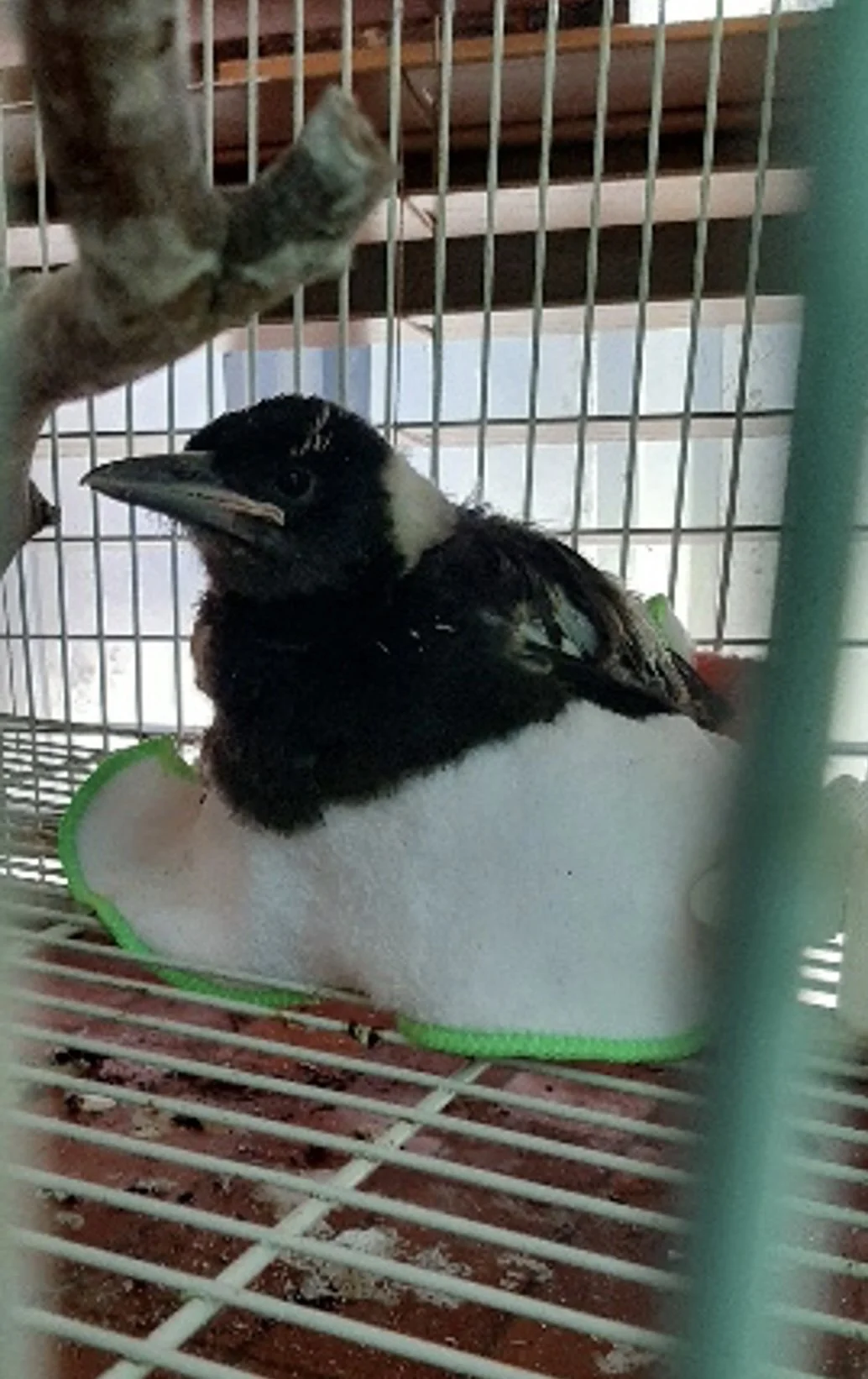
Jolene’s story carries a warning for bird lovers
Wildlife News from Jennifer Berry, Wildlife Volunteers Assoc. Inc (WILVOS) 54416200
www.wilvos.org.au
Jolene the magpie came into care from a wildlife hospital as a fledgling, not yet able to fly and not quite fully feathered, weighing 176g.
It was obvious early on that she wasn’t quite right, as her feathers were not well formed. Over the first couple of weeks in care, she started to put on weight on a special insect-based diet. She was housed in a good-sized cage and received filtered sunlight for a number of hours each day.
But, while she was growing, she didn’t seem steady on her legs and wasn’t showing any signs of wanting to fly, which concerned her carer. Her feathers were also not developing well, and she spent all day in her makeshift nest. When placed on a perch she would not stand or move much.
Jolene’s carer realised that something was seriously amiss and suspected Metabolic Bone Disease (MBD). MBD in birds is a serious, often painful condition primarily caused by deficiencies in calcium, phosphorus, Vitamin D or lack of natural sunlight. Often termed rickets in young birds or nutritional hyperparathyroidism in adults, it leads to soft/brittle bones, fractures, and beak deformities or fractures. Common signs include weakness, a broken beak, lameness, lethargy, and, in severe cases, death.
Her carer planned to feed Jolene a high calcium diet for about two weeks to see if she improved. However, when she started to lose weight and was found early one morning unable to support her head, she was taken to the wildlife hospital. X-rays revealed deformities in the bones of her wings which meant she would never be able to fly. MBD was confirmed as the underlying cause and sadly Jolene was euthanized.
Feeding a bird’s parents human food during the baby bird’s development (from the time the egg is laid to fledging), presents a high risk of MBD or other vitamin deficiency issues.
Kind people love feeding their birds but are unaware that they are just one of many people feeding them a potentially inappropriate diet. Wild birds are opportunistic and often have a ‘round’ of places they regularly visit to scrounge for food from these well-meaning people.
The best practice is to not feed wild birds. If you must, feed them their natural diet such as worms, roaches or grasshoppers. You could also invest in a wild bird supplement such as Insectivore to dip their treats in before feeding. Importantly, the young birds should not be fed live insects, including grubs, as these can damage the bird’s crop, part of the digestive system.