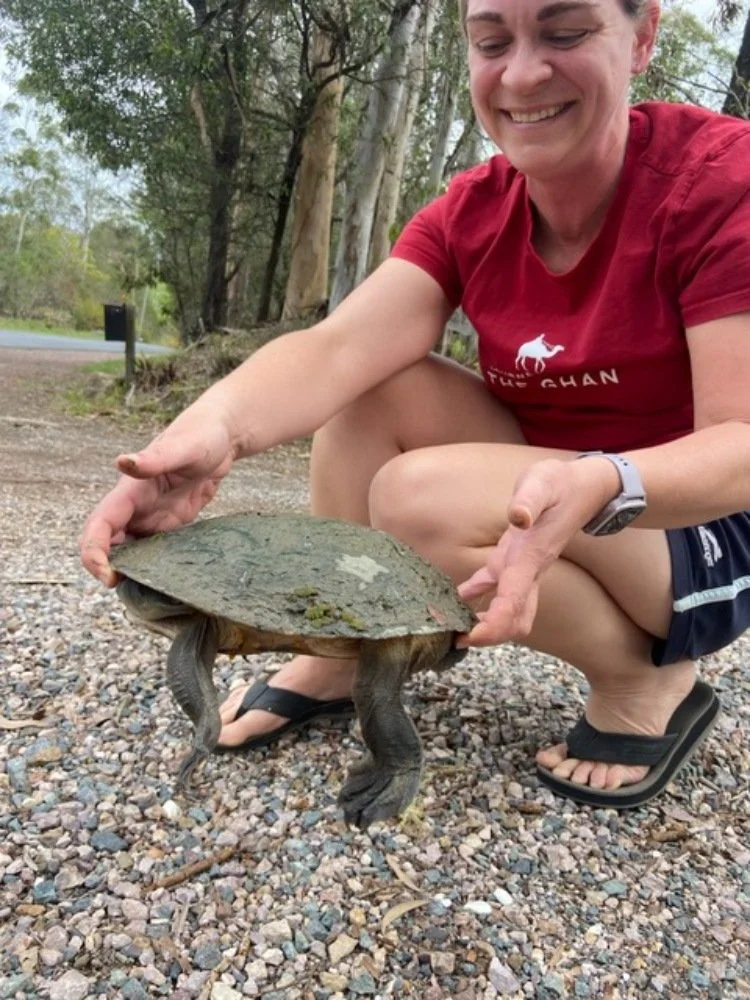
Freshwater turtles: How to rescue and assess for injury
Wildlife news from Jennifer Berry,
Wildlife Volunteers Assoc. Inc (WILVOS)
54416200 www.wilvos.org.au
Freshwater turtles spend most of their lives in water (dams, inland creeks and rivers), only leaving to find new water bodies or to nest. They take advantage of rainy periods to seek out different water bodies with fresh vibes, better food, and new mates.
Unfortunately, turtles are extremely vulnerable to vehicle strikes. If you encounter a turtle on the road, please stop and check the turtle if it’s safe to do so, or call the WILVOS hotline on 07 5441 6200 for assistance.
The easiest and safest way to pick up a turtle is by the top shell (the carapace) at the front and back, above the head and tail – this way, there is less chance of dropping the turtle, as it can’t push on you with its strong feet.
Once you and the turtle are safely off the road, check for injuries: its head should retract strongly into the shell, all four legs should be strong – no floppiness. Check the carapace and the lower shell (plastron) for cracks, abrasions, or bleeding. Do not turn the turtle over to do check underneath, just hold it up flat or tilt slightly and look from below.
If all is well, place the turtle well off the road in the direction it was travelling. If you can see water nearby, point it that way.
If there are signs of injury or illness, transport the turtle to a wildlife vet (Eumundi Wildlife Rehabilitation Centre or Australia Zoo Wildlife Hospital) for assessment. If you don’t have a box or cage, place the turtle on the back floor of your car.
NEVER place an injured turtle into water. If you need to keep a turtle overnight before taking it to a vet, secure it in a box or cage lined with a soft towel, and put it in a dark, quiet place away from pets.