
Community Centre backs safety, but warns bill may miss true mark
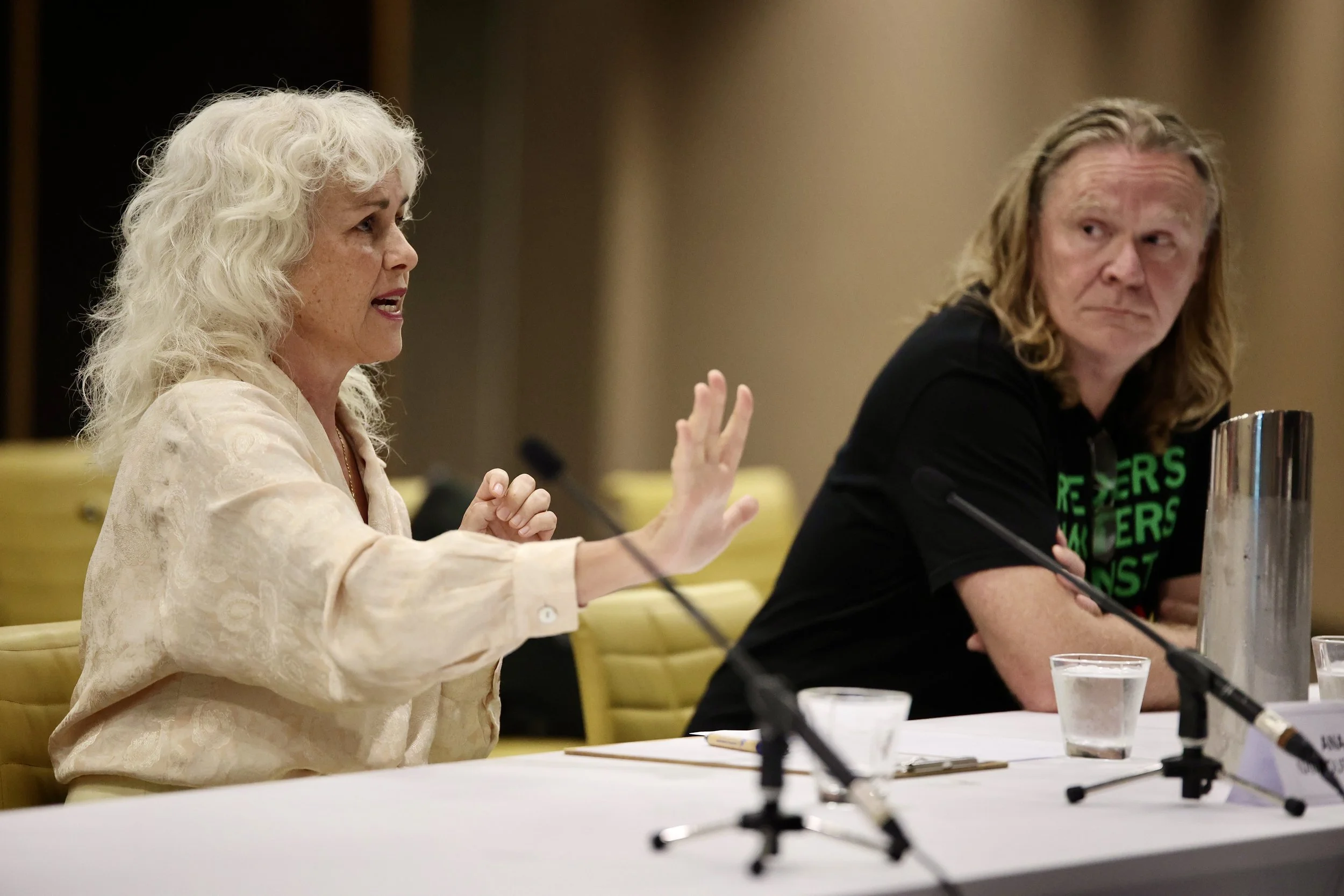
Ana Greenfield and Peter Hogg: “For some members of our community, public space is not optional. It’s where daily life happens.”
Nambour Community Centre representatives Ana Greenfield and Peter Hogg have told a parliamentary hearing that while the community’s demand for safety was valid, the proposed new police powers risked moving vulnerable people around without dealing with the deeper problems driving anti-social behaviour.
Appearing before the Justice, Integrity and Community Safety Committee in Nambour on March 30, the pair made clear they support strong boundaries on behaviour – but questioned whether the legislation, as drafted, would deliver lasting change.
“At Nambour Community Centre, all people are welcome, but not all behaviours,” Ms Greenfield said.
That principle, she said, underpinned how the centre operated, including permanently banning seven individuals over the past eight years for “multiple instances of extreme behaviour”.
But she warned that simply removing people from spaces does not resolve the issues behind that behaviour. “We know that exclusion does not resolve the underlying issue,” she said.
“When we exclude people … our slow work with them stops and the problem is moved on to another community.”
The proposed laws would allow police to move people on from designated precincts and ban repeat offenders from public areas for up to a month. Ms Greenfield said she supported “the goal of safer public spaces” but raised concerns about how the powers would work in practice. “For some members of our community, public space is not optional,” she said. “It’s where daily life happens.”
She questioned what would happen once people were moved on. “When a person is excluded from a precinct, where do they go? And what support is available to them?”
Mr Hogg, who works daily with people sleeping rough or in crisis, said the idea that support systems were readily available did not match what he saw on the ground. “It’s not a fair assessment,” he said. “I work with people every single day that have been waiting for housing for years.”
He told the hearing of a single mother with three children who came to the centre seeking help. “We spent six hours trying to secure some form of accommodation for her,” he said.
“The best we could do … was give her a tent and send her out to the streets because every service … is at and beyond capacity.”
Mr Hogg said that reality pointed to a deeper issue. “This is a societal issue,” he said. “It’s not a failure of weak laws. It’s not a case of weak policing.”
He warned that relying too heavily on enforcement risked escalating the problem rather than resolving it. “As long as we’re dealing with this as a behavioural and a criminalised issue, we’re dealing with symptoms. We are not dealing with the cause.”
Both witnesses accepted the broader community’s expectation of safety. Asked directly, Ms Greenfield said: “Community safety is paramount.”
She also spoke about the impact of anti-social behaviour on frontline workers.
“Any time somebody abuses me, I get shattered,” she said. “So I really feel for people that are shopkeepers who don’t have the skills that we have.”