
Families rally to save Nambour’s 75-year-old community kindy
by Cameron Outridge
A 75-year-old community kindergarten in Nambour is fighting for its future after State Government policy blocked a proposed move to higher ground, leaving families and educators scrambling for solutions ahead of the 2026 school year.
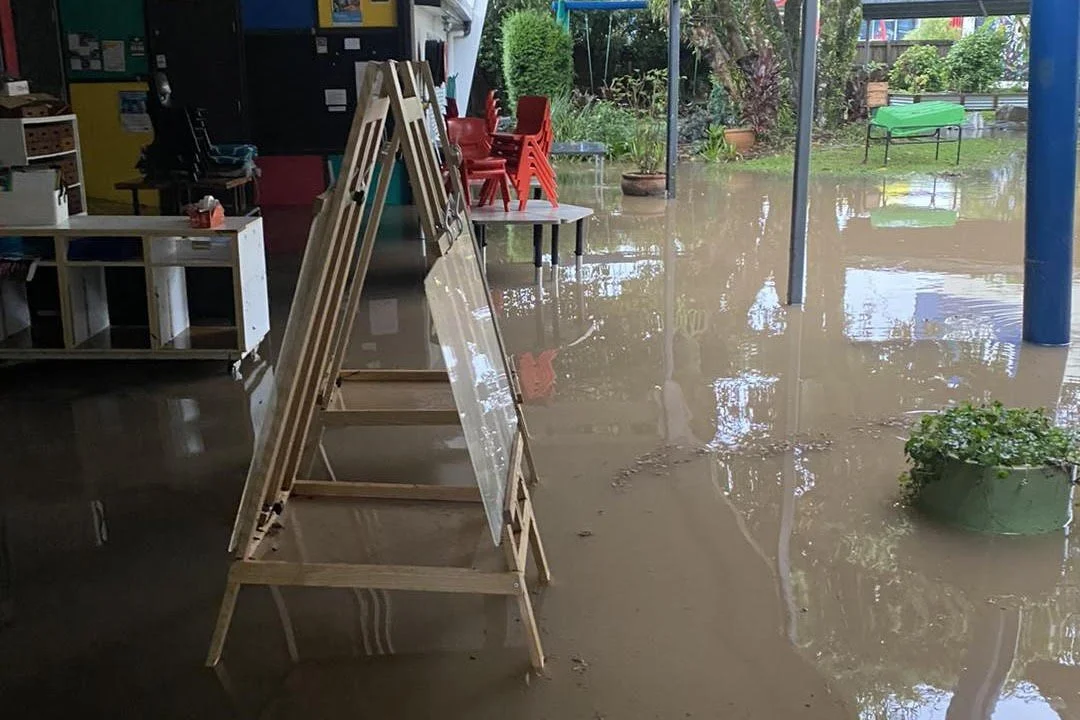
Nambour Community Kindergarten in James Street, a not-for-profit service owned and run by local families, was inundated in March when ex-Tropical Cyclone Alfred delivered 750mm of rain in a single day. Floodwater swept through the building and playground, forcing a five-week closure and temporary relocation to a nearby Kindy.
Six months later, new flood mapping has made it impossible for the centre to rebuild. The kindy can no longer obtain flood insurance unless the building is raised by five metres – an unachievable requirement for a small volunteer-run organisation.
In September, the kindy put forward a cost-neutral proposal to relocate to a vacant building at Nambour State College, with support from the school community and administration. Grants and fundraising would have covered most upgrades required under the National Quality Standard.
But the Department of Education rejected the proposal, advising families that government policy restricts school-based kindergartens to areas with no other early learning options. Because Nambour has several long-day-care centres with vacancies, the department deemed there was “no need” to place a community kindergarten on a school site.
A spokesperson for the kindergarten said the decision failed to recognise what the community stood to lose.
“Our centre has served Nambour families since 1955,” the spokesperson said. “Community kindergartens are different to long-day-care models. Children have the same teacher and educator every day, the same classmates each session, smaller groups, stable relationships and a high-quality play-based program. This shouldn’t be taken away because of a natural disaster.”
The kindy, which consistently exceeds National Quality Standards, is now urging the Minister for Education to review the decision, arguing that the loss of the service would permanently remove a free, community-run option for Nambour families.
A Change.org petition has attracted more than 800 signatures.
Local MP Marty Hunt said he understood the frustration but noted there were practical and legislative barriers at the school site, including fencing, toilet and outdoor upgrades, town planning impacts and potential material change-of-use requirements.
“I’ve strongly advocated for our local kindy,” Mr Hunt said. “While the school site won’t be ready for 2026, the Department is working on solutions. Importantly, no child will miss out on kindy next year.”
The kindy’s volunteer management committee said the fight was far from over.
“We’re exploring plan B, C and D — council land, government land, private land, partnerships,” the spokesperson said. “A natural disaster shouldn’t remove the right of Nambour children to access a community kindergarten. Every Community Kindergarten on the Sunshine Coast has full enrolments with extensive waiting lists demonstrating that the model is one consistently supported by families - while Nambour has two Community Kindergartens both centres worked together to ensure families were given choice of shorter school hours at James Street or longer day hours at Brooke Street.”
The centre now hopes to form a steering committee of local supporters to secure a long-term home for one of Nambour’s oldest early-learning institutions.
Why community kindergartens matter: What Nambour stands to lose
Community kindergartens have been part of Queensland life for generations, offering a style of early education that differs significantly from long-day-care kindy programs. As Nambour faces the possible loss of its 75-year-old community kindy, educators say families risk losing a model built on stability, relationships and affordability.
Unlike childcare centres, where staff work rotating shifts, community kindergartens have the same teacher and educator with children every day. At Nambour, one assistant has worked for 31 years, the director for 26 years and a co-teacher for 12 years. “Secure, consistent relationships with familiar adults are critical for children’s development,” a spokesperson said.
Children also attend in fixed groups, meaning they see the same classmates each session. Educators say this stable “kindy family” builds confidence, trust and belonging, something harder to achieve in large, shift-based centres where groups change daily.
Community kindergartens also maintain safer staffing ratios, budgeting for two educators at all times regardless of attendance. If enrolments reach 24, a third staff member is added.
Most importantly for families, the program is free, with all State Government funding used locally for wages, resources and maintaining the centre, not for shareholder profit.
“These centres are small, personal and community-owned,” the spokesperson said. “Losing one is losing a whole way of delivering early childhood education.”