
Four-gram finches rescued & set for release after nest fall
Wildlife News from Jennifer Berry, Wildlife Volunteers Assoc. Inc (WILVOS) 54416200 www.wilvos.org.au
A call came in via our 24hr hotline recently after a member of the public (MOP) rescued four tiny baby birds found in a fallen nest. The MOP had tried to reunite them by placing the nest back in a tree, but sadly there were no parents around to tend to them.
When WILVOS carer Mel took the tiny birds into care, each chick weighed just 4 grams. Their eyes were open and they had feathers on their wings and bottoms but were otherwise completely bald, which meant they were probably 7-10 days old.
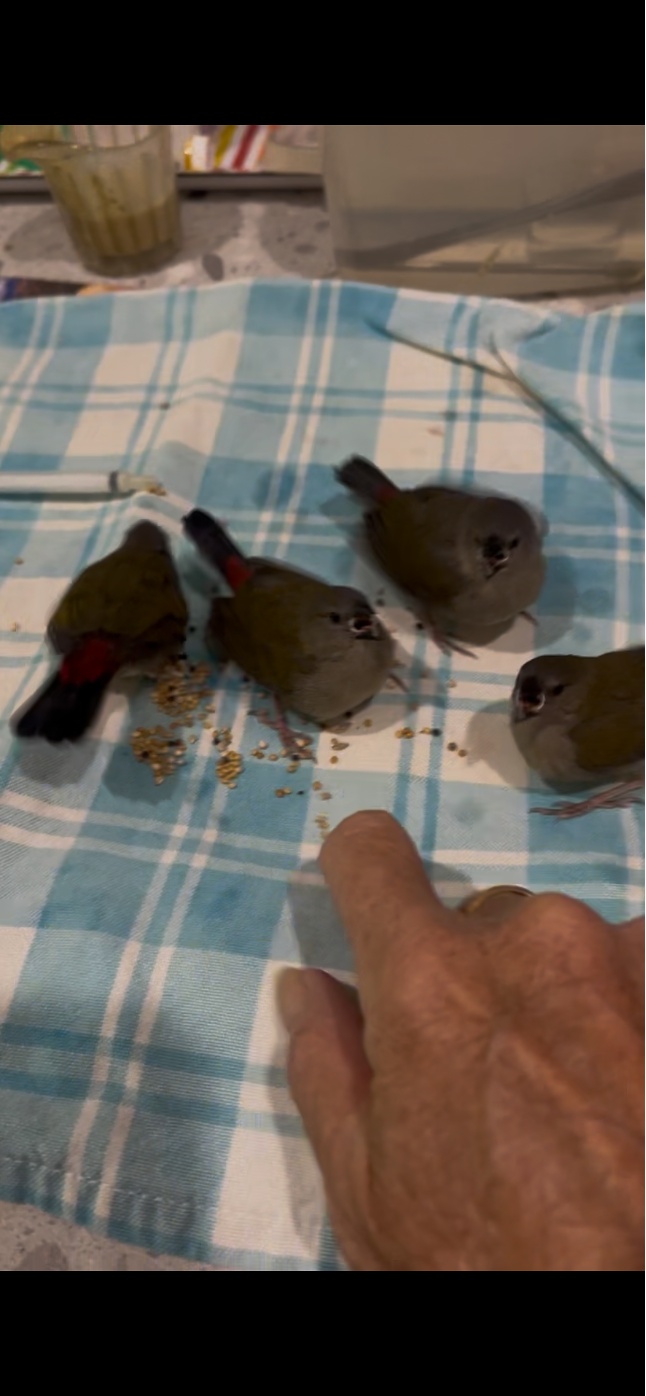
Mel, who is very experienced in caring for these birds, noted their red tail feathers and identified them as Red-browed Finches. Adults are distinguished by a bright red stripe above the eye and a bright red rump, while the rest of the body is olive green.
Incredibly, the babies were very keen to feed. Mel initially fed them every 2-3 hours from dawn to dusk, using a 1ml syringe containing a thin mixture of Insectivore and Neocare (specialised solutions for raising wildlife in care).
When feeding this way, which is a slow process, the chicks use their tongues to suck in the mixture and store it in a pouch called a crop, which fills like a tiny funny bubble on either side of their necks. The crop needs to be empty before the next feed.
Baby Red-Browed Finches are initially kept in a humidicrib at 31C. They develop very quickly and get very excited at mealtimes, flapping their wings and calling for food.
As their feathers come in and they start learning to fly around the age of 17-21 days, they transition to eating finch seed and an assortment of grasses and weeds such as chickweed and milk thistle.
They are the sweetest little birds and love to bathe in a small dish of water. Sunlight is very important, but they must have protection, as Butcherbirds love baby birds for breakfast!
These chicks are now 6.5g and getting ready for release in another week or two. Four little babies back to the wild. Great outcome.