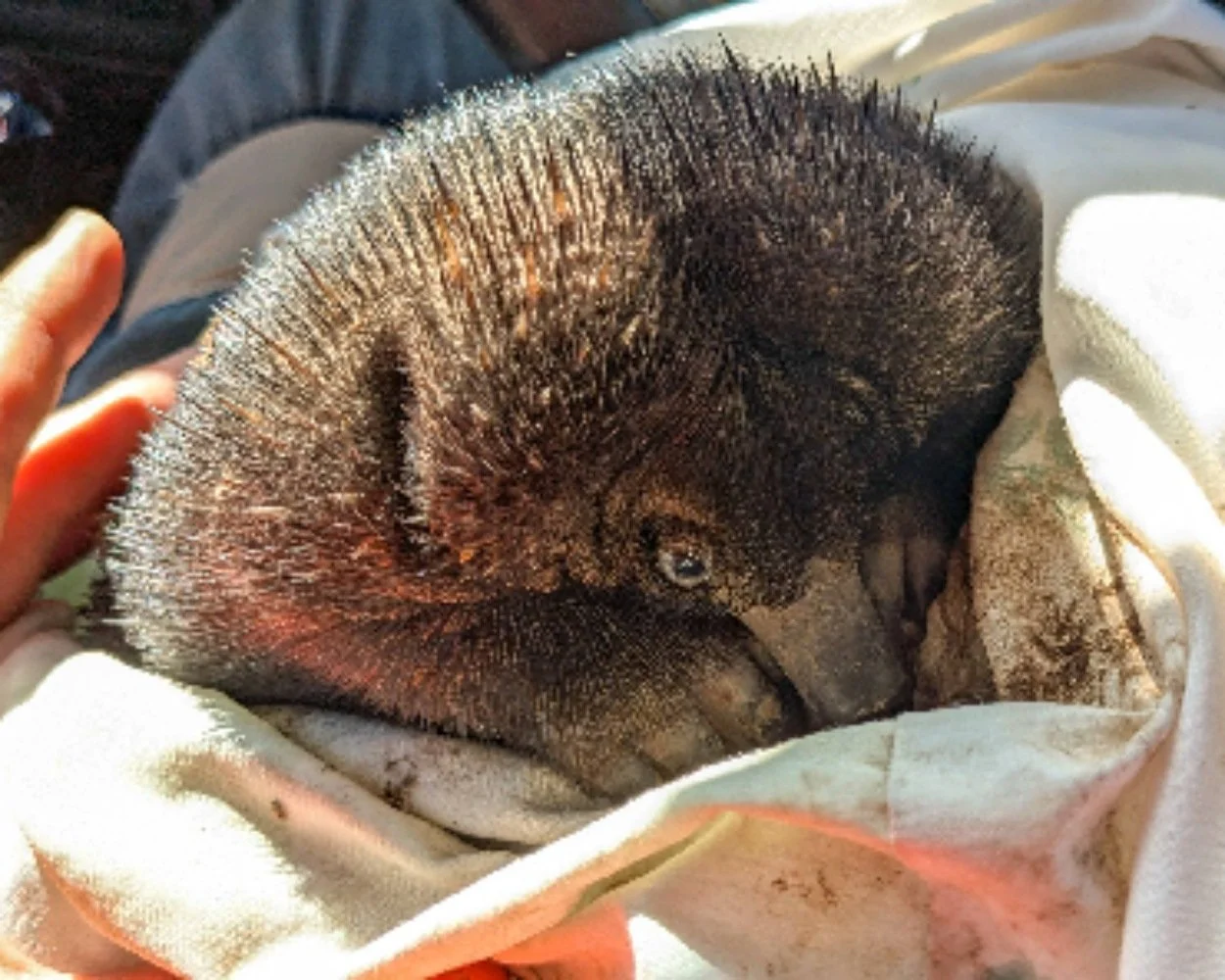
Emerging from burrow can be a risky time for young echidnas
Wildlife news from Jennifer Berry, Wildlife Volunteers Assoc. Inc (WILVOS) 54416200 www.wilvos.org.au
Young echidnas, known as puggles, emerge from their burrows in February/March each year. This can be a risky time for them, encountering cars, dogs or other hazards. If you come across one, please contact WILVOS Hotline (07) 54416200 for assistance.
Echidnas breed in the wintertime. If you’re lucky enough you may see an ‘Echidna Train’— up to ten males following a female!
The gestation period is 23 days, and a shallow pouch develops for this special occasion, where mamma curls up into a sitting position and deposits her egg into the pouch. Some females go into a burrow and stay there until hatching, but others just continue their daily routine.
The egg is 14-16mm, soft and leathery—it elongates before hatching and weighs around 0.3gms- the egg hatches after 10.5 days. Once hatched, the puggle uses its strong front legs to cling to the hairs on its mother’s belly while feeding from a milk ‘patch’. The milk patches sit on either side of the pouch, roughly where nipples would normally be.
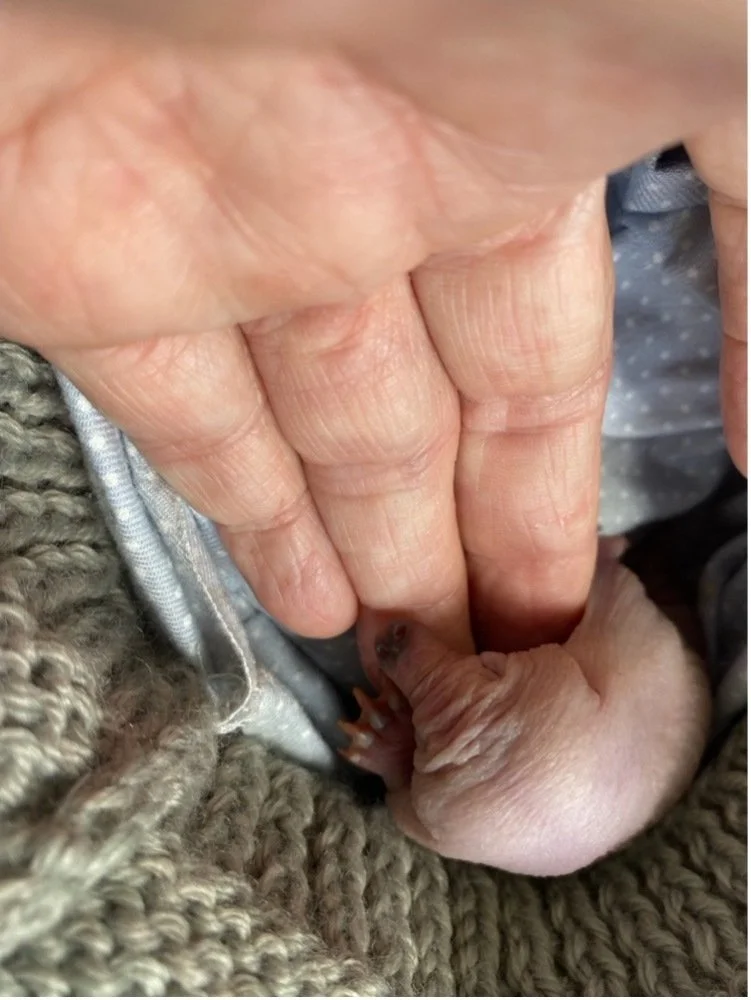
Once in the pouch at 90% humidity, it grows quickly, going from 0.3g to 1g in two days. By Day 14 it will be 30g—a 100x increase in weight! By this time pigmentation starts on the beak, and 2-3 weeks later a light fuzz appears on the skin.
Mamma echidna carries the young puggle for about 50 days until it starts to develop spines, at which point she deposits it in a nursery burrow. She forages for up to 18 hours per day and travels one or more kilometres. She can dig 1000 holes searching for food. She returns to the burrow every 5-6 days and stays for about 2 hours to feed her young puggle. She lies on her side while baby suckles up to 40% of its bodyweight in milk.
The puggle’s eyes open after a couple of weeks in the burrow. By 6 months its spines will be fully developed, and by 7 months it will be fully weaned and ready to emerge.