
From model partnership to a bureaucratic malaise: Maleny’s Precinct story
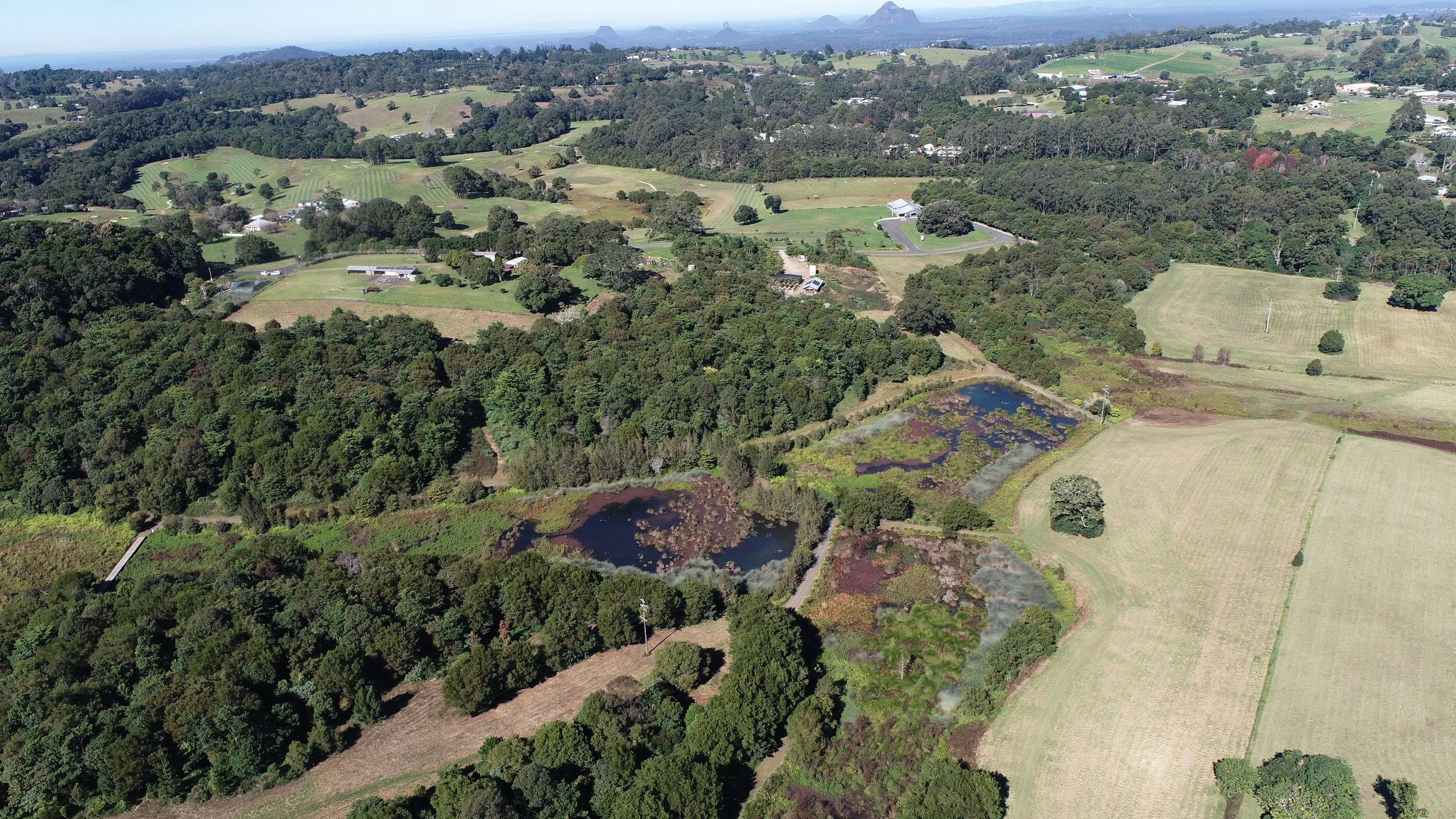
A drone image of Maleny Precinct. The golf club is in the top left corner.
By Dr Max Whitten AM, former Maleny Golf Club President. Volunteer on all Maleny Precinct Advisory Groups since 2001
In October 2025, Council CEO John Baker told the Nambour Chamber of Commerce that Council would shift from a “paternalistic approach to genuine partnerships” as reported in the Gazette. He went further, describing many council consultation approaches as “more than frustrating” and “actually disrespectful to the community”.
A year later, in August 2026, Mr Baker returned to the theme in My Weekly Preview. Promoting a concept called “authoring our future”, co-championed by Mayor Rosanna Natoli, the pair encouraged “residents to play an active role in shaping the region’s direction rather than simply responding to change after it arrives”. Really?
Other parts of the Sunshine Coast may have had different experiences, but let’s look at Council’s consultation record in Maleny and the hinterland, focusing on the Maleny Community Precinct.
The Precinct comprises two former 64-hectare dairy farms, Armstrong’s and Porter’s, a few minutes’ walk from the CBD along a beautiful riverside trail that passes two platypus viewing platforms. It personifies “authoring our future”, driven by a dynamic partnership between Council and community. Or at least it did for 15 years.
It began in July 2001, when the Maleny Golf Club asked to build a golf course on the former Armstrong Farm. Caloundra City Council had bought the farm in 1995 to dispose of the Maleny township’s treated effluent. Council officers then explored buying the neighbouring Porter Farm to create a Precinct combining a golf course, other sports, recreation, heritage and environmental sub-precincts. It would include some residential land to finance these ambitious improvements, a business model that would not drain core Council finances.
In June 2010, Sunshine Coast Council adopted a Master Plan for the Precinct that captured that vision splendid. Our community didn’t simply “respond to change after it arrived”. The plan was shaped by close collaboration between the community and Council officers who were capable, committed and dedicated to real outcomes. There were public meetings (with more than 300 attendees on two occasions), taskforces, consultants and advisory groups where, occasionally, mutual respect was strained. But we got there.
A site visit today reveals extensive walking trails, boardwalks, wetlands, heritage sites, rainforests and open spaces. A wonderful example of planned serendipity, the Precinct has great potential for “forest bathing”, a Japanese therapeutic practice gaining popularity in Australia. It boasts a well-appointed Bridge Club with panoramic views. This month, the 18-hole community golf course won the 2026 Golf Australia Award as the finest regional golf course in Queensland. Barung Landcare and a rejuvenated Pattemore House are also on site.
Maleny and its hinterland proved large enough to hold substantial social capital, especially the experience and life skills of retirees, yet small enough for volunteers to feel a sense of ownership of worthy community projects. That happy combination was harnessed by visionary community leaders and some capable Council officers dedicated to genuine public service.
Cooperation, consolidation, regression
That was essentially the story of the Precinct from 2000 to 2015. The years 2016 to 2020 were largely a period of consolidation. Unfortunately, things have gone backwards since 2020. Community consultation by Council has, at best, been spasmodic and, at times, disrespectful, as Mr Baker himself noted a year ago.
Five of Council’s six Group Executives have since been replaced, so it may be too early to expect change. But there are clues that a reboot of a collaborative mindset among senior managers is still a work in progress. Face-to-face community meetings are rare. Respectful letters and emails bring delayed responses or are simply ignored. These responses suggest a lack of corporate memory, or of appreciation for commitments enshrined in Council resolutions.
A standard email response to community groups from one area of Council reads: “Processing times may be longer than usual due to staffing changes and limited capacity.”
A more worrying response was this: “it is very important to manage your club’s expectations and state upfront, honestly and transparently, that there are no council funds allocated nor earmarked to fund improvements within the Precinct and no council funding to progress any Master Plan recommendations over the next 10 years of council’s capital works program. Therefore any funding discussions will need to focus on external grant funding and a potential staged approach which we can discuss further when we meet.”
Officers working at the level where outcomes are delivered are being given a message from above that conflicts with enduring Council policy, reflected in Council resolutions OM10/266 and OM22/40. The response also ignores the fact that Council can still sell Precinct land zoned residential, in both the current planning scheme and the draft scheme, to finance further Precinct projects.
Instead, Council is proposing a “District Park” to absorb all unallocated Precinct land, including the residential land. This costly in-house exercise has been six years in the making, with no end in sight. It includes elements that didn’t come from the community, such as a mountain bike facility, and no budget has been set. There is an otherwise excellent dog off-leash park, but it lacks needed amenities such as disabled access. Completion of the trail network appears to depend more on Council officers’ priorities than on the community and its councillor. The Precinct now reflects the bureaucratic malaise the CEO and Mayor are decrying.
Both the CEO and the Mayor are enthusiastic about a “citizens panel” to address the need for consultation, with panel members receiving $700 for their advice. However, a review of the model at Mornington Peninsula Shire Council, where Mr Baker first introduced it, indicates that their Citizen Panel was abandoned as soon as the CEO shifted north.
As reported in The Mornington News (21 January 2025), the more obvious criticism is what Cr Allen and Mayor Marsh had to say about relevance: Cr Andrea Allen stated: “my concerns about the citizens’ panel is one, having a random bunch of people give their opinions, I would prefer to have the people that are actually impacted by what we’re consulting on to be the ones to tell us what they think. My other concern is that all these people are paid $800 for participating. We have some other advisory groups where they’re not paid all, and they also contribute a lot.”
Speaking to The News, Mayor Cr Anthony Marsh said he agreed with Allen. “We have several advisory groups, whether they’re coastal or disability or arts and culture – none of those people are compensated or paid to come and give their advice, they do it out of the goodness of their heart and they want to contribute to the community,” he said.
“Secondly, we use the panel to ask questions on a whole range of issues and sometimes the panelists would not be the most informed or impacted or the best people to ask for these particular things.
“On other things, there’s 170,000 residents. Why should 50 capitalise or monopolise the consultation on these issues?”
At the end of the day, Councillors must ask themselves whether they are providing the leadership we elected them to provide.