
Candidates outline differences at Fisher community forum
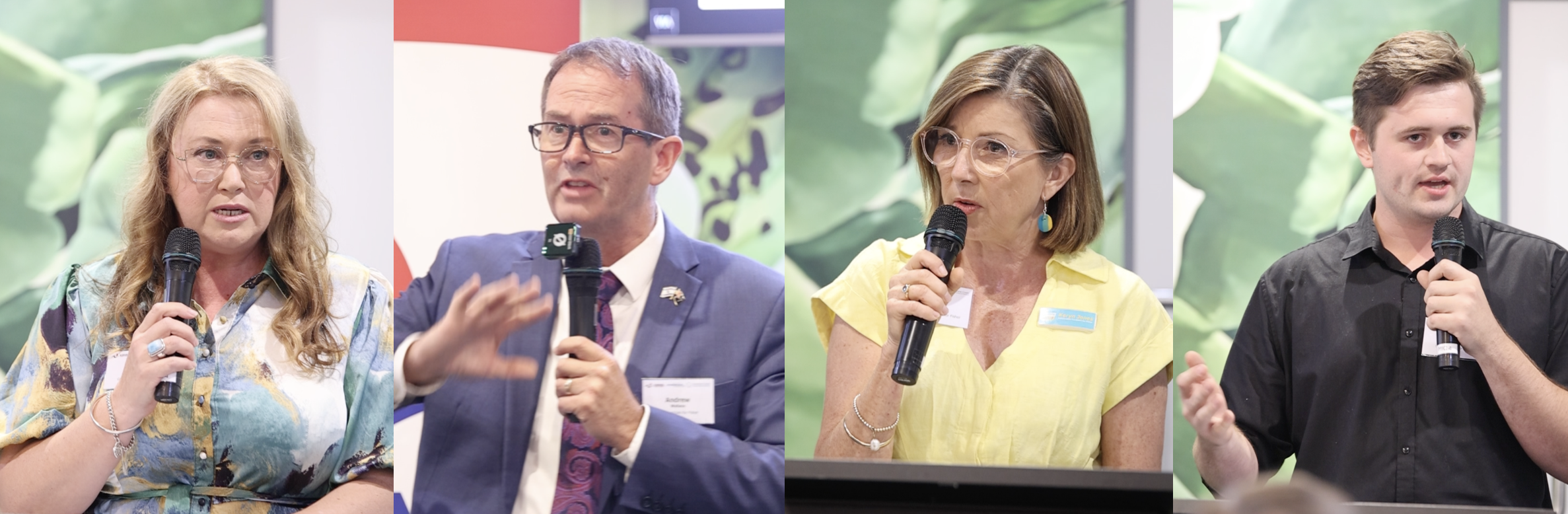
From left, Renee Wells (Greens), Andrew Wallace (LNP), Keryn Jones (teal independent) and Morrison Lakey (ALP).
by Cameron Outridge
Infrastructure, energy costs and support for small businesses emerged as key priorities as Fisher's federal election candidates presented their visions to the business community at Parklands Tavern on Tuesday night (April 16).
The meet-the-candidates event, organised by local chambers of commerce, gave voters a chance to evaluate incumbent Andrew Wallace (LNP) alongside challengers Morrison Lakey (Labor), Renee Wells (Greens) and community-backed teal independent Keryn Jones ahead of the May 3 election.
With forecasts suggesting a probable minority government, the forum highlighted differences between the candidates on issues critical to the region's economic future.
Candidates present their cases
Incumbent LNP MP Andrew Wallace emphasised his nine-year track record of delivering "$7.2 billion worth of road, rail and community infrastructure" to the region. Drawing on his background as a builder and barrister, Wallace highlighted his commitment to mental health reform, particularly in the treatment of eating disorders, and his experience on the Intelligence and Security Committee.
"I want the Sunshine Coast to be a place where our kids can grow up, where they can learn, earn, and retire," Wallace said. "The last thing I want is for young people to feel like they need to move somewhere else to get a decent job."
Morrison Lakey (ALP) presented himself as a "lifelong local" with deep roots in the community. Born in Nambour and raised in Eudlo, Lakey shared a personal story of his father's early passing and his family's reliance on community support.
"I'm running for Parliament fundamentally to give back to the community that's given me and my family so much," Lakey said. He defended the Albanese government's economic record: "When Labor came to office, inflation and interest rates were going up, and now they're both coming down."
Keryn Jones, running as an independent, touted her 35 years of experience on the Coast, including her time as a Sunshine Coast councillor and co-founder of an electrical contracting business that became one of the first grid-connect solar businesses in the region.
"For decades, Fisher has been a safe seat. And what has that meant? We've been left waiting," Jones argued. "Marginal seats get the big bucks, and we are told to be patient. Well, we've waited long enough."
Renee Wells, representing the Greens, presented her credentials including a master's degree in business and extensive experience in sustainability consulting.
"I am here to push for real action on climate, economic justice, and social equity," Wells said. "The Australian Greens offer bold but achievable solutions with every policy independently costed by the parliamentary budget office."
Infrastructure: The top concern for voters
Infrastructure dominated the evening's discussion, with candidates acknowledging the pressures of rapid population growth on the region's roads and transport systems.
Wallace defended his record, claiming credit for securing initial funding for rail to the Coast. "It was Ted O'Brien and myself who secured the first downpayment on the rail into the coast of $1.6 billion," he said, while criticising the Labor government for cutting funding for the Mooloolah River interchange and Third Avenue projects.
Jones said that despite decades of representation by both major parties, Fisher was still waiting for critical infrastructure. "We're still waiting for the Mooloolah River interchange... the Palmview to Birtinya Green Bridge vanished without a trace, action on the Caloundra 'roundabout of doom,' promises and promises."
Wells called for "serious federal investment into clean, integrated transport, including the bus rapid transit system," while advocating for climate-resilient infrastructure.
Lakey suggested establishing advisory forums to better understand community needs, particularly regarding small business infrastructure requirements.
Energy policy sparks debate
The discussion on energy policy revealed differences, with Wallace advocating for an "agnostic approach" that would include nuclear power.
"You can't run a full-time economy on a part-time energy system," Wallace said, criticising Labor's energy policies. "What we will do as the Coalition is ensure that we keep the lights on. We will invest more in gas ... and as coal-fired power stations come to their end of life, we will convert or build nuclear power stations."
Lakey defended the Albanese government's energy plan, arguing that renewable energy costs continue to decrease every year. "Australia has one of the greatest solar and wind resources on the planet," he said, while acknowledging the challenges of transitioning the country's electricity system.
Wells dismissed nuclear power as a viable option, stating, "Nuclear power stations will not be built in a majority of people's lifetimes. It will take 30 years to build these things."
Jones called the suggestion that renewable energy was responsible for price increases "laughable," attributing rising costs to gas price hikes after Russia's invasion of Ukraine and decades of policy uncertainty.
"We have the most abundant solar and wind resources in the world. We could be the solar energy and wind energy global capital of the world," Jones argued. "Every single credible analyst will tell you the cheapest by far form of energy, including with storage, is renewables."
Small business support
All candidates emphasized their commitment to supporting the region's small businesses.
Wallace, citing his 30 years of small business experience, criticised the Albanese government saying "30,000 small businesses have gone belly up" under its leadership. He pledged that a Coalition government would extend and make permanent the instant asset write-off from $1,000 to $30,000 and halve the fuel excise from 50 cents to 25 cents.
Lakey highlighted Labor's extension of the $20,000 instant asset write-off for another 12 months, energy bill relief for small businesses, and measures to strengthen enforcement of the franchising code of conduct.
Jones proposed making her office "a go-to hub for business, helping access grants, cut through red tape, wade through regulation, and connect with the right support services."
Wells promised support through "targeted federal investment in the clean economy, manufacturing innovation, especially in industries that are regenerative, circular and future-proof."
Minority government prospects
With polls suggesting a potential minority government, candidates offered differing perspectives on how they would handle that scenario.
Lakey said Labor intended to win the election outright but noted his party's track record of working effectively with the crossbench in the Senate during the current term.
Wells welcomed the prospect: "The fact that there's a minority government on the horizon is very exciting. The Greens have proven that we can work constructively to achieve real outcomes."
Jones argued that minority governments often delivered better outcomes "because they require negotiation, collaboration, and a focus on practical results," adding that as an independent, she would be in "the strongest position to represent Fisher, not frozen in opposition but at the table negotiating."
Wallace rejected the idea, saying, "I hope that the next parliament does not see a minority parliament," warning that it would lead to a "Greens, teals, and Labor minority government" that he characterised as "dysfunctional."
Closing Arguments
In her final pitch Wells asked voters to remember that "the Australian Greens have clearly defined and costed policies that tackle the biggest challenges we face: climate change, the housing crisis, and the soaring cost of living."
Jones emphasised her independence from party politics, saying, "I won't answer to a party room, I'll answer to you. I'll work with whoever's in government, assess policies on merit, and back ideas that make sense."
Wallace highlighted his nine-year record of hard work for Fisher residents and the LNP's focus on home ownership. "The LNP is the party of small business. The LNP is the party of home ownership going right back to Robert Menzies."
Lakey positioned the election as "an opportunity for that generational change on the Sunshine Coast," highlighting Labor's "Future Made in Australia" plan to "turn Australia into a renewable energy superpower" and create "hundreds of thousands of secure, well-paid jobs."
Australian voters cast their ballots on May 3.